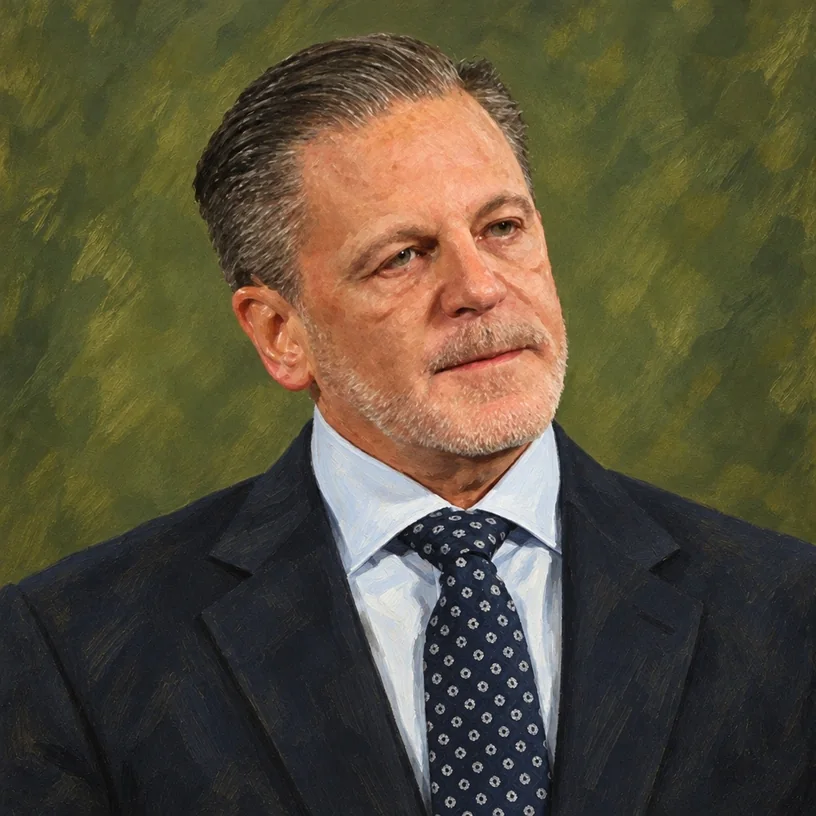
Daniel Gilbert
Rocket Companies cofounder and chairman; Bedrock founder; Cleveland Cavaliers principal owner
Dan Gilbert built Rock Financial into the mortgage business now known as Rocket Mortgage, combining centralized operations, consumer marketing, and digital applications. He also became a major downtown Detroit property investor and Cleveland Cavaliers owner. His record includes substantial civic commitments, mortgage-compliance controversy, and recovery from a serious stroke.
“If you do just one thing better than your competition, they’ll eventually figure it out and your advantage will be gone.”
The story
Daniel Gilbert grew up in the Detroit area, earned a bachelor’s degree at Michigan State University, and completed a law degree at Wayne State University. In 1985, he cofounded Rock Financial with partners including his brother Gary Gilbert. Rather than building his career around practicing law, he concentrated on the mortgage business. Rock eventually embraced direct lending and the internet, seeking to simplify a transaction traditionally organized around local branches and extensive paperwork. His early story illustrates the value of combining industry familiarity with a willingness to change distribution, while remembering that mortgages remain complicated financial obligations rather than ordinary online purchases.
Intuit acquired Rock Financial in 1999, and the business became Quicken Loans. Gilbert led an investor group that bought it back in 2002. The company expanded a centralized lending model supported by technology, advertising, and a deliberately articulated employee culture. Its Rocket Mortgage brand brought the digital application process to a wider consumer audience, and parent Rocket Companies went public in 2020. These milestones were not a solo software achievement: lending required underwriting, funding, servicing, and customer support. The practical takeaway is to connect a compelling customer interface to dependable operations instead of mistaking a polished application for the entire business.
Gilbert moved Quicken Loans’ headquarters to downtown Detroit in 2010 and developed a major property business through Bedrock. Building restoration and new development made him an unusually influential private actor in the city’s downtown recovery. Alongside those investments, the Rocket Community Fund and Gilbert Family Foundation announced a combined $500 million, ten-year Detroit commitment in 2021. Downtown redevelopment, however, cannot by itself resolve citywide housing insecurity or unequal access to opportunity. A balanced reading separates commercial appreciation from measurable community benefits. Entrepreneurs pursuing place-based investment should evaluate resident stability and neighborhood outcomes alongside occupancy, construction spending, and increases in property value.
Gilbert became principal owner of the Cleveland Cavaliers in 2005, and the team won its first NBA championship in 2016. His wider record also contains serious challenges. In 2019, Quicken Loans agreed to a $32.5 million settlement resolving federal allegations concerning FHA-insured mortgages, without admitting wrongdoing. That same year, Gilbert suffered a stroke and began a lengthy rehabilitation. His subsequent public appearances offer evidence of persistence, not a reason to romanticize illness. Taken together, the story suggests that durable organizations need documented culture, delegated leadership, and independent compliance controls so that performance does not depend entirely on the founder’s energy or confidence.
Accomplishments
- Cofounded Rock Financial in 1985, the predecessor of the lending business now branded Rocket Mortgage.
- Led the investor group that repurchased Quicken Loans from Intuit in 2002.
- Became principal owner of the Cleveland Cavaliers in 2005; the franchise won the 2016 NBA championship.
- Helped launch a combined $500 million, ten-year Detroit commitment through the Rocket Community Fund and Gilbert Family Foundation in 2021.
Top 10 lessons
- 01
Redesign the customer journey.
Map the customer’s complete mortgage journey, including document collection, approval, closing, and servicing. Identify one confusing handoff and remove it before adding features. Gilbert’s direct-lending approach is a useful prompt to improve distribution, but convenience must never obscure borrowing costs or repayment obligations.
- 02
Make culture operational.
Translate values into observable behaviors, onboarding exercises, and escalation rules. Gilbert’s ISMs show how a founder can repeatedly communicate expectations. Test whether employees actually use those principles when making difficult decisions; a memorable slogan is not evidence that incentives and behavior align.
- 03
Improve many small things.
Create a recurring review of minor customer frustrations and operational errors. Assign owners and track whether fixes persist. The useful interpretation of Gilbert’s emphasis on little things is cumulative reliability, not obsessive interference with every employee’s work or an excuse to avoid strategic choices.
- 04
Connect software to execution.
Before promoting a faster digital experience, verify that underwriting capacity, funding, service teams, and exception handling can support it. Measure completed outcomes rather than application starts alone. A beautiful interface can accelerate confusion if the operating system behind it remains fragmented or unreliable.
- 05
Understand the credit cycle.
Model what happens when refinancing demand falls, rates rise, or housing transactions slow. Use conservative volume assumptions when hiring and borrowing. A recognizable consumer brand does not eliminate the cyclicality of mortgage origination, so preserve flexibility rather than treating strong demand as a permanent condition.
- 06
Keep compliance independent.
Give risk and compliance teams authority to challenge production targets and document exceptions. The FHA settlement is a reminder that high volume requires strong controls. Review sampled files, reward accurate reporting, and distinguish sales success from evidence that borrowers and government insurance programs are protected.
- 07
Invest in a coherent geography.
Concentrating investments within one district can improve coordination among offices, retail, housing, and public space. Map those relationships before buying isolated assets. Also set exposure limits: geographic coherence can create operational advantages while leaving the portfolio vulnerable to the same local employment or financing shock.
- 08
Measure community outcomes.
For redevelopment or philanthropy, define outcomes that residents can recognize: fewer evictions, safer housing, or access to jobs. Publish timelines and distinguish commitments from money actually deployed. Private development and public benefit can overlap, but neither increased property values nor attractive buildings prove inclusive progress.
- 09
Build beyond the founder.
Document critical decisions, identify deputies, and rehearse an extended founder absence. Gilbert’s stroke makes continuity planning especially relevant without reducing his experience to a management metaphor. Strong institutions protect employees and customers by distributing knowledge and decision authority before an emergency forces the issue.
- 10
Separate confidence from certainty.
Use ambitious goals to motivate effort, then evaluate assumptions separately. Ask an independent colleague to describe how a major initiative could fail. Ownership, sports, lending, and redevelopment all involve uncertainty; confidence is useful only when paired with evidence, feedback, and a willingness to revise decisions.
Books
- No books yet — start with the interviews.