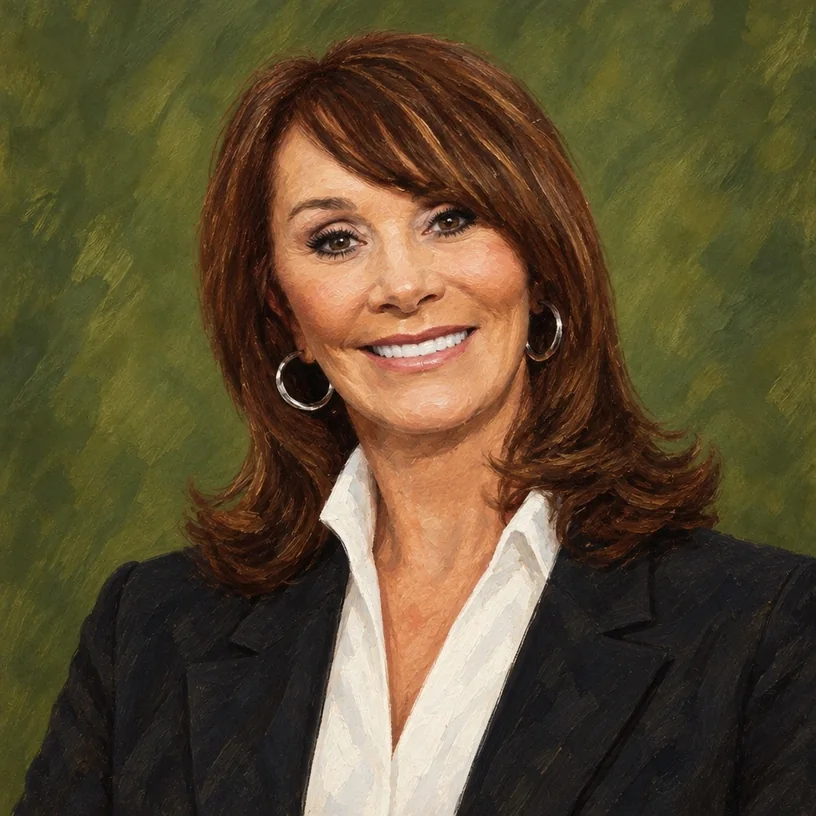
Diane Hendricks
ABC Supply cofounder and chair
Diane Hendricks built a national building-products distributor with her husband Ken, then continued expanding it after his death. Her experience connects contractor service, acquisition discipline, and the demands of succession.
“You don’t quit, you don’t walk away from a challenge. You just don’t quit.”
The story
Diane Hendricks grew up on a Wisconsin dairy farm and later entered real estate, an industry that rewarded direct attention to buildings, tenants, and financing. With Ken Hendricks, she invested in properties and helped build businesses connected to roofing and construction. Their experience was not simply a motivational prelude to a larger company: it exposed them to the practical problems contractors faced when buying materials. In 1982, they founded American Builders and Contractors Supply, later known as ABC Supply. The applicable lesson is to study the frustrations surrounding work you already understand before assuming that a promising opportunity must involve an unfamiliar industry.
ABC Supply began with the acquisition of three supply centers from Bird & Sons during the economic slowdown of 1982. Its proposition was straightforward: treat contractors respectfully and provide the products and services that helped them run their businesses. That positioning made distribution, rather than manufacturing a new product, the central opportunity. Over time, the company expanded through branches and acquisitions into a national operation. Its official history records 256 stores by 2002. The practical takeaway is that an ordinary industry can contain substantial room for improvement when customers repeatedly encounter unreliable service, inconvenient purchasing, or suppliers who misunderstand their daily work.
Ken Hendricks died in an accident at their home in December 2007, leaving Diane to decide whether to retain or sell the business. The timing compounded personal loss with commercial uncertainty as the housing downturn developed. She chose to continue, working with the company's management rather than treating ownership as a substitute for an operating organization. ABC subsequently acquired Bradco in 2010 and L&W Supply in 2016, broadening its reach and product mix. This history illustrates resilience, but not a universal instruction to keep every struggling business. A succession decision needs financial information, capable colleagues, and an honest assessment of what the owner can sustain.
Hendricks also developed a portfolio through Hendricks Holding Company and invested in the redevelopment of Beloit, Wisconsin. Those activities connect business ownership with the surrounding community, although a company biography naturally emphasizes favorable outcomes rather than independently measuring every local effect. ABC's expansion should likewise be understood as the work of employees, managers, suppliers, and acquired businesses, not one person's determination alone. Her career offers a useful model of customer focus and patient ownership without establishing that every acquisition or concentrated investment is wise. For a smaller operator, the transferable practice is to improve service, reinvest carefully, and prepare leadership continuity before a crisis makes it urgent.
Accomplishments
- Cofounded ABC Supply with Ken Hendricks in 1982.
- Continued leading ABC Supply as chair after Ken Hendricks died in 2007.
- Oversaw expansion that included Bradco in 2010 and L&W Supply in 2016.
- Coestablished Hendricks Holding Company in 2001.
Top 10 lessons
- 01
Start with a customer problem you know.
Interview customers in an industry you already serve and list recurring delays, purchasing frustrations, and costly workarounds. The Hendrickses drew on roofing experience when building ABC Supply. Choose one problem you can solve reliably before adding products, locations, or a more ambitious brand promise.
- 02
Make respect visible in daily service.
Translate customer respect into observable behavior: accurate orders, clear delivery commitments, prompt callbacks, and fair handling of mistakes. ABC Supply made contractor service central to its identity. Ask customers which interaction wastes their time, then assign one employee responsibility for improving that experience.
- 03
Learn the cash cycle before expanding.
Map when you pay suppliers, hold inventory, and collect from customers. A distributor can grow sales while consuming cash. Before opening another location, calculate the working capital needed under slower collections and weaker demand, and keep a reserve that does not depend on optimistic forecasts.
- 04
Buy capabilities, not just revenue.
For any acquisition, identify the specific benefit you need: geographic coverage, product expertise, supplier relationships, or a stronger team. ABC expanded through acquisitions, but size alone is not evidence of value. Write an integration plan and downside case before agreeing to a purchase price.
- 05
Protect the operating team during succession.
When ownership changes or a founder leaves, clarify who controls operations, financing, and customer communication. Hendricks continued after her husband's death with an existing organization. Preserve useful institutional knowledge while checking whether responsibilities and incentives still match the company's size and immediate needs.
- 06
Build repeatable branch standards.
Document a small set of nonnegotiable service standards while allowing local managers to respond to local conditions. Distribution networks need consistency without unnecessary bureaucracy. Review delivery reliability, inventory accuracy, safety, and customer complaints together so that sales growth cannot conceal an increasingly fragile operation.
- 07
Reinvest with a long ownership horizon.
Decide which improvements will strengthen the business over several years rather than merely increase this quarter's reported sales. Compare reinvestment with debt repayment and cash reserves. Hendricks's continued ownership illustrates patience, but a long horizon still requires milestones and a willingness to stop weak projects.
- 08
Stay close to frontline work.
Spend scheduled time with warehouse staff, drivers, salespeople, and customers rather than relying only on management reports. Ask what repeatedly goes wrong and what workaround people have invented. Use those observations to test whether a proposed investment addresses a real bottleneck or an executive assumption.
- 09
Measure community commitments.
If you invest in local development, define what success means for residents as well as the business. Track completed projects, accessibility, jobs, or other relevant outcomes. Hendricks's Beloit involvement provides a starting example, not proof that every privately led redevelopment benefits every community member equally.
- 10
Prepare continuity before a crisis.
Create an emergency plan covering signing authority, banking access, key relationships, and interim leadership. Review it with qualified legal and financial advisers. The sudden loss of a cofounder can coincide with a market downturn; continuity planning gives colleagues options when personal circumstances make quick decisions difficult.
Books
- No books yet — start with the interviews.