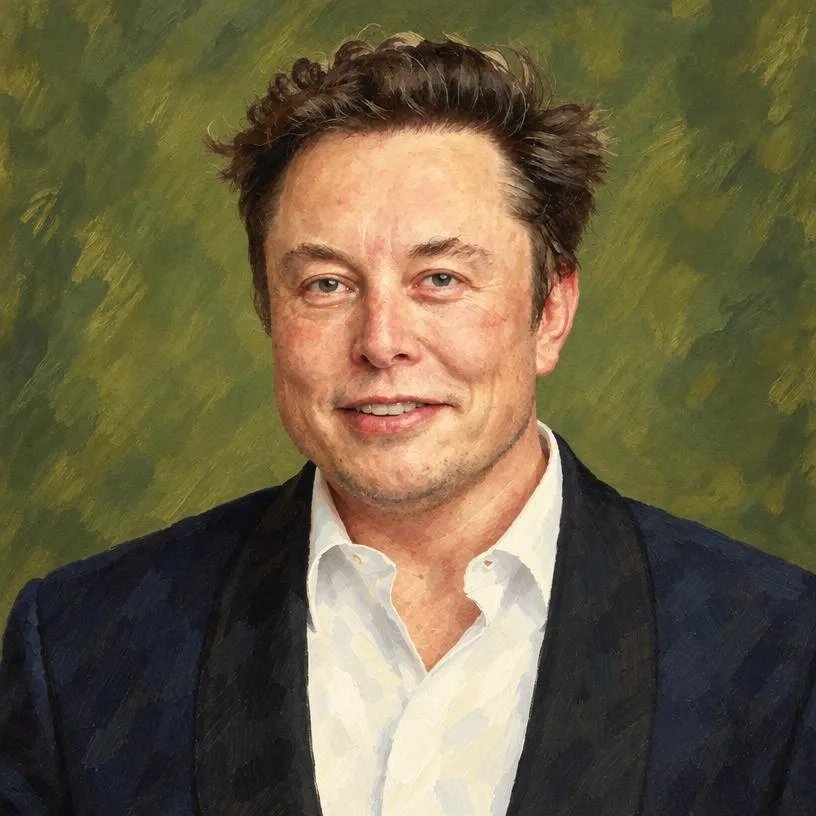
Elon Musk
Entrepreneur behind Tesla, SpaceX and X
Elon Musk builds companies around unusually hard problems — electric cars, reusable rockets, satellite internet — and pushes teams to attempt what incumbents consider unrealistic.
“When something is important enough, you do it even if the odds are not in your favor.”
Listen to story & lessons
The story
Elon Musk was born in Pretoria, South Africa, in 1971 and taught himself to program as a child, selling a small video game at about twelve. He moved to Canada at seventeen, attended Queen's University, then transferred to the University of Pennsylvania, earning degrees in physics and economics. He briefly started a Stanford PhD before leaving within days to join the internet boom. That choice set the pattern for his career: he repeatedly left safe paths to work on problems he considered important, accepting personal risk most people would avoid. His early companies were unglamorous — an online city guide called Zip2 and an online payments startup that became part of PayPal — but the payouts from selling them gave him the capital, and the credibility, to attempt far harder things.
In 2002 he founded SpaceX to lower the cost of reaching orbit, and in 2004 he joined Tesla as its largest investor and later its leader. Both companies nearly died in 2008: SpaceX's first three rockets failed, Tesla was running out of cash, and Musk has said he split his remaining money between them. The fourth Falcon 1 launch succeeded, NASA awarded a major contract, and Tesla survived to make the Roadster and later the Model S. Reusable rocket landings, once dismissed as fantasy, became routine. These years explain his reputation better than any slogan: he commits to technical goals with long odds, funds them himself when necessary, and treats each failure as engineering data rather than a verdict.
Musk's later ventures — SolarCity, Neuralink, The Boring Company, xAI and his 2022 purchase of Twitter, renamed X — extended that approach into energy, brain interfaces, tunnels, artificial intelligence and social media. The record is genuinely mixed. Tesla made electric cars desirable and forced an entire industry to follow; SpaceX reshaped the launch business. At the same time, Musk has faced SEC action over tweets, lawsuits, missed deadlines by years, and persistent criticism of his management style, his political statements and his handling of X. Admirers and critics often describe the same traits — intensity, impatience, appetite for risk — and simply weigh them differently.
The usable lesson from Musk's career is not to imitate his hundred-hour weeks or his public combativeness. It is the discipline of first-principles thinking: break a problem down to what is physically true, ignore what the industry assumes, and ask what a solution would cost if you rebuilt it from scratch. Pair that with a tolerance for being wrong in public and iterating quickly. Most people should also notice the context that made his bets survivable — rare technical talent, early financial cushions and an unusual tolerance for stress. Take the method, scale the risk to your own life, and leave the mythology behind.
Accomplishments
- In 1999, he sold Zip2 to Compaq for roughly 300 million dollars.
- In 2002, eBay bought PayPal for 1.5 billion dollars, and he founded SpaceX the same year.
- In 2008, SpaceX's Falcon 1 became the first privately developed liquid-fuel rocket to reach orbit.
- In 2012, Tesla launched the Model S, and SpaceX began delivering cargo to the International Space Station.
Top 10 lessons
- 01
Work on problems that matter to the future.
Musk chose fields — energy, transport, space — where progress changes daily life for millions. You do not need his scale to use the filter: pick work whose success would still matter to you in ten years, not just this quarter.
- 02
Reason from first principles, not analogy.
First principles means pricing a rocket from raw materials instead of accepting what rockets cost. Try it on your own problem: list what you assume is fixed, then check which of those are actually physics and which are just habit.
- 03
Expect failure and design for iteration.
SpaceX's early rockets failed publicly, and each failure was dissected for data. Build your projects so a failed attempt teaches you something specific — a small launch, a cheap prototype, a limited test — rather than betting everything on one perfect try.
- 04
Take your big risks before obligations pile up.
Musk made his riskiest moves in his twenties and early thirties, before heavy obligations. If you want to attempt something bold, do it while your fixed costs are low and your recovery time is long.
- 05
Outwork the competition when it counts.
His companies famously outwork incumbents at decisive moments. The honest version for your life: sustained effort matters most in short, chosen sprints — a launch, an exam, a deadline — not as a permanent state.
- 06
Hire for talent and drive, not credentials.
Musk hires for demonstrated ability over pedigree. When you build anything — a team, a project, a habit — judge by what people actually do, including yourself, not by titles or intentions.
- 07
Keep feedback loops brutally honest.
He is known for demanding direct technical truth from engineers. Create your own version: ask one person you trust to tell you what is not working, and make it safe for them to answer honestly.
- 08
Simplify the product before optimizing it.
Tesla's design philosophy deletes parts before improving them. Before optimizing your schedule, budget or project, remove the steps that should not exist at all.
- 09
Sell the vision, not just the product.
Musk sells a future — Mars, sustainable energy — that makes hard present work feel meaningful. When you need others' support, explain the destination, not just the task list.
- 10
Keep learning across many fields.
He moved from payments to rockets to cars by reading deeply in each field. Keep a learning habit that crosses boundaries; the most useful ideas often arrive from outside your own industry.