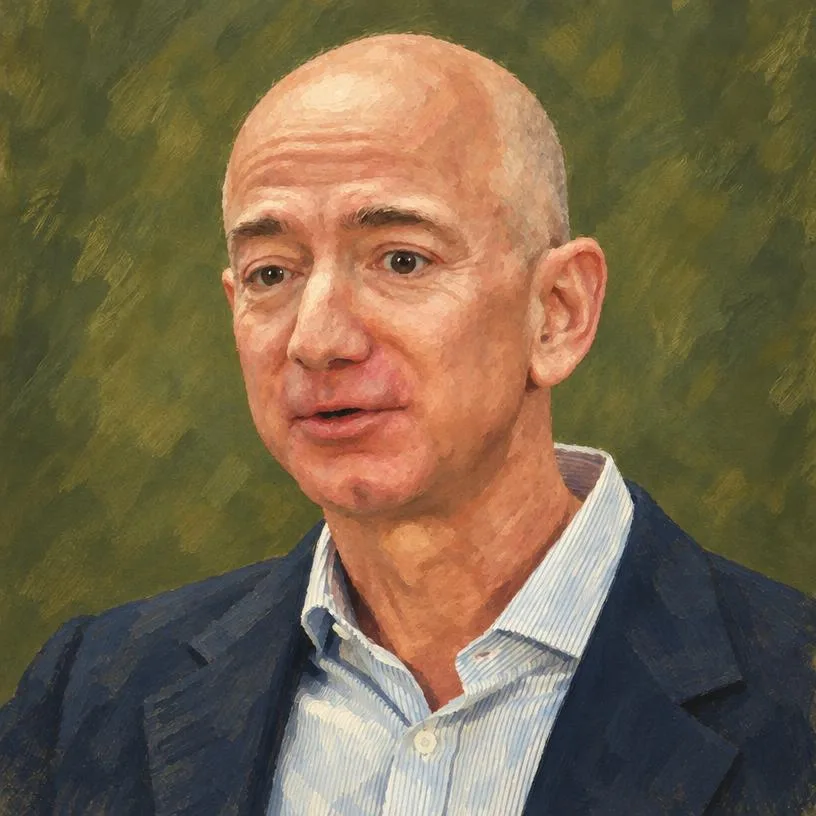
Jeff Bezos
Amazon founder and Blue Origin founder
Jeff Bezos left a Wall Street career to start an online bookstore in a garage, then grew Amazon by thinking in decades, experimenting constantly and starting every decision with the customer.
“If you double the number of experiments you do per year, you're going to double your inventiveness.”
Listen to story & lessons
The story
Jeff Bezos was born in Albuquerque in 1964 and raised in Houston and Miami. He spent summers on his grandfather's Texas ranch fixing windmills and laying pipe — an education in self-reliance he still credits. A strong student in physics and computer science, he graduated from Princeton in 1986 and built a successful Wall Street career, becoming a senior vice president at the hedge fund D. E. Shaw by thirty. In 1994 he read that web usage was growing at more than two thousand percent a year, and he made the decision he later explained with his 'regret minimization framework': he imagined himself at eighty and asked which choice he would regret less. He quit, drove to Seattle, and started an online bookstore from a garage.
Amazon opened in 1995 and grew with a discipline that confused observers for years: Bezos reinvested nearly everything, accepted losses Wall Street hated, and kept expanding — from books to music, to everything, to the marketplace, to the Kindle, to Amazon Web Services. AWS, launched in 2006 from internal infrastructure, became the company's profit engine and quietly reshaped how the internet is built. Bezos codified his approach in annual shareholder letters that became management classics: customer obsession, long-term thinking, willingness to be misunderstood, and the insistence that it is 'always Day 1'. He stepped down as CEO in 2021, remaining executive chairman.
His story has a necessary shadow side. Amazon has faced sustained criticism over warehouse working conditions, its effect on small retailers, its tax arrangements and its market power, and Bezos personally became a symbol of extreme wealth inequality. He has also directed large sums toward Blue Origin, his space company founded in 2000, toward the Bezos Earth Fund, and toward The Washington Post, which he bought in 2013. A fair reading holds both facts at once: the operating principles genuinely built something unusual, and the scale of that something created genuine harms and responsibilities that no management philosophy settles by itself.
For a reader, the transferable core of Bezos's method is surprisingly personal. The regret-minimization framework is a clean tool for any large decision. 'Day 1' is a reminder that organizations and habits decay the moment they start defending yesterday. Working backwards from the customer translates, at small scale, into starting any project from the person it serves. And his patience — seven years of losses, decades of reinvestment — is an argument for choosing a time horizon your competitors, or your own impatience, will not match.
Accomplishments
- In 1995, he launched Amazon.com from a Seattle garage as an online bookstore.
- In 1997, Amazon went public; it survived the dot-com crash that destroyed most of its peers.
- In 2000, he founded Blue Origin to work on reusable spaceflight.
- In 2006, Amazon Web Services launched and grew into the world's leading cloud platform.
Top 10 lessons
- 01
Start with the customer and work backwards.
Amazon's product process starts with a mock press release written for the customer. Before building anything, write one paragraph describing who it helps and why they would care; if the paragraph is weak, the idea is not ready.
- 02
Think in decades, not quarters.
Bezos has said that if you're willing to think in three-year horizons you compete against many, and in seven-year horizons almost no one. Pick one goal where you can simply out-wait the crowd's attention span.
- 03
Treat every day like Day 1.
Day 1 means treating success as rented, never owned. Build a small ritual — a weekly review, a beginner's question — that keeps you from coasting on what worked last year.
- 04
Decide with about 70% of the information.
Bezos argues most decisions should be made with about 70% of the information you wish you had; waiting for 90% is usually too slow. For reversible choices, decide, note what would prove you wrong, and move.
- 05
Experiment more than feels comfortable.
He credits Amazon's scale of experimentation for its successes, and accepts that most experiments fail. Raise your own experiment count: cheaper, smaller, more frequent trials beat occasional grand attempts.
- 06
Be stubborn on vision, flexible on details.
His phrase is 'stubborn on vision, flexible on details'. Write your goal as a fixed direction, then hold every plan for reaching it loosely enough to replace without feeling defeated.
- 07
Keep teams small enough to move fast.
Amazon's 'two-pizza teams' kept groups small enough to act without committees. In your projects, shrink the decision circle to the few people who actually do the work.
- 08
Choose the path you'll least regret.
The regret-minimization framework: project yourself to age eighty and ask which choice you would regret. Use it sparingly, for the few genuinely large forks — careers, moves, commitments — where short-term fear distorts the answer.
- 09
Obsess over inputs, not the stock price.
Bezos told investors to ignore the stock price and watch the inputs: customer experience, selection, speed. Choose two or three inputs you control, measure those, and let outcomes follow.
- 10
Leave room to wander — exploration feeds invention.
His book is titled Invent and Wander because he insists efficiency and exploration need each other. Schedule some unoptimized time — reading outside your field, a project with no deadline — and defend it as seriously as your productive hours.