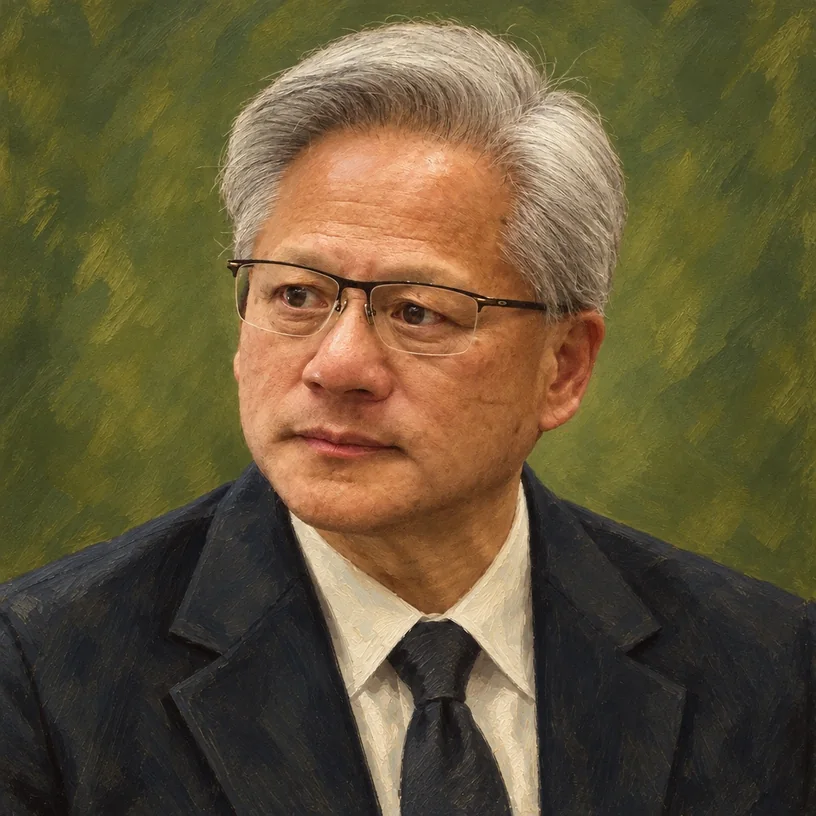
Jensen Huang
NVIDIA cofounder, president, and CEO
Jensen Huang cofounded NVIDIA in 1993 and led its evolution from graphics chips to a central role in accelerated computing and artificial intelligence. His career illustrates technical adaptability, long-term platform investment, and the importance of surviving early strategic mistakes.
“If you believe this is going to change the computing industry altogether, for what reason don’t you take this first move? Just start.”
The story
Jensen Huang trained as an electrical engineer, earning degrees from Oregon State University and Stanford University before building experience at AMD and LSI Logic. In 1993 he cofounded NVIDIA with Chris Malachowsky and Curtis Priem to pursue graphics computing. The opportunity was promising but far from secure: the founders were entering a technically demanding market with established competitors and rapidly changing standards. Huang’s subsequent prominence can obscure that uncertainty. The practical starting lesson is to combine a clear technical thesis with people who can execute it, while recognizing that a persuasive explanation of the future does not eliminate the need to earn customers.
NVIDIA’s first chip, the NV1, was a commercial disappointment, and the company faced a survival crisis in the mid-1990s. Its early technical approach did not fit the direction that the graphics market was taking. Recovering required more than optimism: the team had to change course and produce a competitive product. The RIVA 128, introduced in 1997, became an important step in that recovery. This part of Huang’s story is especially useful because it separates determination from stubbornness. Keep investigating the problem you believe matters, but be willing to abandon an implementation when market evidence and technical requirements show that it is wrong.
Over the following years, NVIDIA developed a broader computing platform rather than treating graphics hardware as a single isolated product. The company introduced CUDA architecture in 2006, opening GPU parallel processing to scientific and research applications. In 2012, NVIDIA GPUs powered the AlexNet neural-network breakthrough, helping demonstrate their importance to modern deep learning. These milestones were separated by years, not compressed into an instant pivot after artificial intelligence became fashionable. For builders, the lesson is to invest in tools that let other people discover valuable uses, while maintaining enough financial discipline to support the work before its largest market becomes obvious.
Huang’s leadership helped make NVIDIA a major supplier of the computing infrastructure behind the AI boom, but the story should not be reduced to a stock-price chart or a claim that one executive invented artificial intelligence. Researchers, software developers, employees, manufacturing partners, and customers all contributed to the ecosystem. His public emphasis on resilience also needs careful application: learning from difficulty does not justify manufacturing suffering or tolerating unhealthy workplaces. The useful takeaway is disciplined endurance. Keep decision-making close to technical evidence, build capabilities that compound over time, and distinguish the pressure required to solve a hard problem from avoidable harm to people.
Accomplishments
- Cofounded NVIDIA with Chris Malachowsky and Curtis Priem in 1993.
- Led NVIDIA through its early graphics-chip setbacks and the 1997 introduction of RIVA 128.
- Led the company when it unveiled CUDA architecture in 2006.
- Built the company whose GPUs powered the 2012 AlexNet deep-learning breakthrough.
Top 10 lessons
- 01
Start with a technical thesis you can test.
Describe the change you expect in the world and the evidence that would support or undermine it. Huang’s founders anticipated demand for advanced graphics. Turn a broad conviction into a prototype, customer conversation, or benchmark rather than using confidence about the future to avoid testing present assumptions.
- 02
Choose cofounders for execution.
Identify which technical and commercial responsibilities your founding team must cover. NVIDIA began with three cofounders, not one solitary inventor. Look for demonstrated skill, trust, and the ability to disagree productively, then make ownership of decisions explicit before urgency turns unresolved differences into operational confusion.
- 03
Abandon the wrong implementation.
When a product conflicts with emerging standards or customer requirements, separate the original mission from the current design. NVIDIA’s early graphics difficulties required a change of approach. Set review points that let evidence overturn a favored implementation before pride consumes the remaining time and cash.
- 04
Put survival into the operating plan.
Estimate how long the organization can fund development if the next milestone slips. NVIDIA’s early crisis made survival a practical constraint. Maintain a short list of essential work, explicit spending priorities, and escalation triggers so that long-term ambition is supported by a credible near-term runway.
- 05
Build tools other people can extend.
Ask what customers and developers could accomplish if they had better access to your core capability. CUDA expanded the uses of NVIDIA GPUs beyond graphics. Documentation, libraries, and reliable interfaces can turn a product into infrastructure that others improve through applications you would not have designed yourself.
- 06
Invest before the market becomes obvious.
Reserve resources for a promising capability even when its largest use remains uncertain, but define what you need to learn along the way. NVIDIA’s computing investments preceded the AI boom. Long-term commitment works best when intermediate evidence guides spending rather than when patience becomes immunity from scrutiny.
- 07
Notice unexpected users.
Look for researchers or customers applying your product to a problem outside its original market. GPU use in deep learning helped reveal a larger opportunity for NVIDIA. Interview those users, understand their bottlenecks, and test whether supporting them creates repeatable value rather than merely an interesting demonstration.
- 08
Evaluate the complete system.
A component’s benchmark matters only within the workload it helps complete. When planning a product, examine software, data movement, developer effort, and deployment constraints alongside raw performance. NVIDIA’s platform approach suggests asking where the overall system loses time, rather than optimizing an impressive number in isolation.
- 09
Practice resilience without glorifying harm.
Prepare for setbacks by reviewing failed experiments honestly and defining a manageable next step. Huang often discusses resilience, but hardship is not a management objective. Protect rest, respectful disagreement, and psychological safety so that people can persist through difficult work without treating preventable exhaustion as proof of character.
- 10
Share credit across the ecosystem.
Map the partners, researchers, developers, and employees on whom your results depend. NVIDIA’s success rests on a much broader network than its chief executive. Recognizing those dependencies helps you invest in relationships, avoid unrealistic claims, and identify the fragile links that a founder-centered success story can conceal.
Books
- No books yet — start with the interviews.