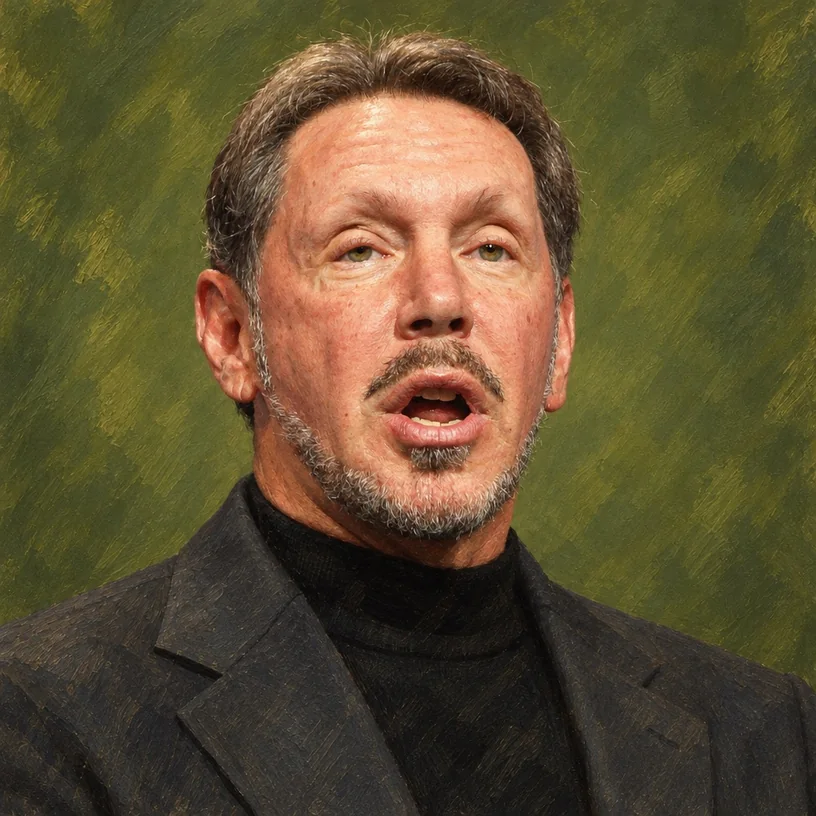
Larry Ellison
Oracle cofounder, executive chairman, and chief technology officer
Larry Ellison helped commercialize relational database software and built Oracle into a major enterprise technology company. His career combines technical timing and competitive sales with a painful lesson in management and financial controls.
“When I started Oracle, what I wanted to do was to create an environment where I would enjoy working.”
The story
Larry Ellison cofounded the company that became Oracle in 1977 with Bob Miner and Ed Oates. The opportunity grew from published research on relational databases, including the work of IBM researcher Edgar F. Codd. Rather than claiming to have invented the underlying mathematical ideas, Ellison described the challenge as bringing the technology to market ahead of a much larger incumbent. That distinction makes the origin story useful beyond software: research can create an opening, but customers still need a working product and a dependable supplier. A smaller organization can compete by executing on a focused application of a significant idea before established companies fully commit to it.
Oracle developed database software for organizations that needed to store, retrieve, and manage important information. Its growth depended on turning a technical architecture into a commercial offering that businesses could deploy and support. Ellison's role combined product ambition with forceful selling and a determination to challenge larger competitors. The achievement was organizational as well as technical, involving developers, sales teams, and customers willing to adopt the product. For an entrepreneur, the applicable lesson is to connect an engineering advantage with an expensive customer problem. A technically elegant system is not automatically a durable business unless deployment, reliability, support, and purchasing decisions are addressed as seriously as the core invention.
Rapid expansion also exposed Oracle's weaknesses. In his Academy of Achievement interview, Ellison described 1990 as an especially difficult period, when the company suffered a loss and confronted serious management problems. He said the team that had run a much smaller business did not necessarily possess the skills needed for a billion-dollar company, and acknowledged how painful replacing longtime colleagues could be. This is not a reason to discard people whenever growth slows. It is a warning that loyalty cannot replace appropriate systems, responsibilities, and experience. Founders need accurate reporting and an organization capable of supporting the commitments that successful selling creates.
Ellison remained Oracle's chief executive until September 2014, then continued as executive chairman and chief technology officer. The change separated the chief executive position from his ongoing involvement in technology and strategy. His long tenure demonstrates that a founder can help shape a business across several stages, but also makes it important not to confuse personal prominence with the contributions of the wider organization. Enterprise software creates long relationships, and customers must evaluate ongoing costs, interoperability, and dependence on a supplier. The practical takeaway is to build valuable capabilities while preserving trust: compete vigorously, make promises carefully, and adapt leadership structures before the organization outgrows them.
Accomplishments
- Cofounded the company that became Oracle with Bob Miner and Ed Oates in 1977.
- Helped commercialize relational database technology based on published research.
- Served as Oracle chief executive until September 2014.
- Became Oracle executive chairman and chief technology officer in 2014.
Top 10 lessons
- 01
Turn research into a usable product.
Read important research in your field and ask what a customer would need before using it. Oracle's beginnings illustrate commercialization rather than invention from nothing. Build a small working implementation, document limitations, and test whether the idea survives ordinary operating conditions outside a demonstration.
- 02
Choose an expensive customer problem.
Identify a problem whose cost is visible to the buyer: lost time, unreliable information, expensive errors, or difficult coordination. Enterprise databases address consequential organizational needs. Interview users and budget holders separately so that the product solves a real workflow problem and has a credible purchasing path.
- 03
Compete where incumbents hesitate.
Look for a specific opportunity that a larger competitor has not prioritized, rather than declaring that size makes competitors slow. Define what you can ship and support sooner. Oracle's early challenge to IBM offers a timing lesson, not a guarantee that every underdog has an advantage.
- 04
Sell outcomes you can deliver.
Translate product features into customer outcomes, then check whether engineering and support can meet the promise. Aggressive selling creates obligations as well as revenue. Record assumptions in proposals, clarify implementation responsibilities, and refuse commitments that depend on capabilities the team has not yet demonstrated reliably.
- 05
Scale controls alongside sales.
Review financial reporting, contract approval, collections, and delivery capacity whenever growth accelerates. Ellison's account of Oracle's 1990 difficulties shows that commercial momentum can outrun management. Ask which report could reveal trouble early, who verifies it, and whether incentives encourage employees to surface bad news promptly.
- 06
Hire for the next operating stage.
Describe the skills each leadership role now requires rather than assuming an early employee must either keep the same job or leave. Discuss training, complementary hires, and different responsibilities. A larger organization needs additional capabilities, but transitions should be handled clearly and respectfully rather than as personal betrayal.
- 07
Make technical claims testable.
For each important performance or reliability claim, specify a test customers can understand and reproduce. Strong competitive messaging should not outrun evidence. Publish relevant conditions and limitations, and have someone outside the sales chain review the result before turning a favorable benchmark into a broad promise.
- 08
Design for long customer relationships.
Treat implementation, maintenance, documentation, and support as part of the product. Customers adopting critical systems care about continuity and future costs, not just a successful purchase. Review switching barriers and integration choices honestly so that retention comes from delivered value rather than avoidable dependence or confusion.
- 09
Separate founder identity from job title.
List where the founder adds distinctive value and which responsibilities could be handled better by another leader. Ellison continued in technology and board roles after leaving the chief executive position. Review role design periodically instead of equating a change in title with losing relevance or abandoning the mission.
- 10
Study setbacks as closely as wins.
When studying a successful company, reconstruct a difficult year with the same attention given to its founding breakthrough. Identify assumptions, incentives, and reporting gaps that made the setback possible. Convert those observations into an operating checklist rather than explaining the recovery entirely through the founder's personality.
Books
- No books yet — start with the interviews.