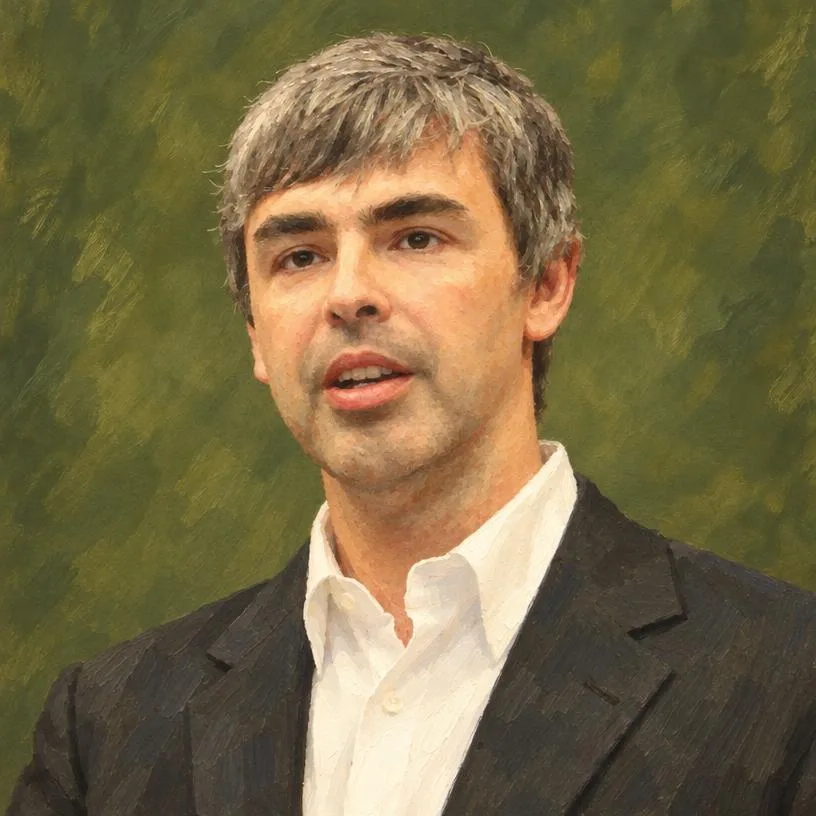
Larry Page
Google co-founder
Larry Page turned a Stanford research project into Google, then kept asking a bigger question: what would a company look like if it aimed for ten times better instead of ten percent?
“Always deliver more than expected.”
Listen to story & lessons
The story
Larry Page was born in Lansing, Michigan, in 1973, into a house full of computers and technology magazines — his father taught computer science, and Page has said the clutter of old equipment shaped him. He studied computer engineering at the University of Michigan, where he built an inkjet printer out of Lego bricks, then began a PhD at Stanford in 1995. There he met Sergey Brin, and a research project about the web's link structure turned into the ranking system that made search actually useful. Page was the quieter, more systematic half of the pair: the one thinking about how the whole company should work, not just the algorithm.
Google was incorporated in 1998, and Page served as its first CEO until 2001, when investors pushed the young founders to bring in Eric Schmidt as 'adult supervision'. Page spent a decade as president of products, then returned as CEO in 2011, reorganized the company around product areas, and made the defining structural bet of his career: the 2015 creation of Alphabet, which separated the profitable Google core from long-shot ventures in life sciences, self-driving cars and internet balloons. He stepped back from the Alphabet CEO role in 2019, remaining a board member and controlling shareholder.
Page's management philosophy is best summarized by his own phrase: '10x thinking'. He argued that aiming for a ten percent improvement means fighting the same competitors with the same tools, while aiming for ten times better forces you to start over — and starting over is where breakthroughs live. That philosophy produced Android, Chrome, Google Maps and the DeepMind acquisition, and also a graveyard of abandoned experiments. His career is not without criticism: Google grew into one of the most powerful companies in history under his watch, attracting antitrust cases, privacy concerns and questions about the concentration of information power that remain unresolved.
The personal takeaway from Page's story is the habit of scaling questions. Most people ask how to do something slightly better; Page's reflex was to ask what the problem would look like solved completely, then work backwards. You can use the same move at any size: instead of 'how do I save a little more', ask 'what would make money stop being a worry'; instead of 'how do I exercise more', ask 'what would make movement automatic'. The audacious version of a question is often easier to act on than the timid one, because it forces real redesign instead of willpower.
Accomplishments
- In 1998, he co-founded Google with Sergey Brin from their Stanford research project.
- In 2005, Google bought Android, which became the world's most used mobile operating system.
- In 2011, he returned as Google's CEO and led the company through its largest expansion.
- In 2015, he created Alphabet, restructuring Google to give ambitious side projects their own space.
Top 10 lessons
- 01
Aim for 10x better, not 10% better.
Page's 10x rule: improving something by ten percent means competing with everyone; improving it ten times means inventing something new. On your next goal, ask what the ten-times version would require — the answer often reveals a simpler, bolder path.
- 02
Always deliver more than expected.
His motto 'always deliver more than expected' built Google's early reputation one search at a time. In your work, find the small extra — the follow-up note, the polished detail — that costs you little and compounds into trust.
- 03
Mine your frustrations for ideas.
Google began with Page's frustration that finding things on the web was broken. Keep a list of your own recurring annoyances; each one is a candidate project that you already understand better than any outsider.
- 04
Organize information so it helps everyone.
Google's mission — organize the world's information and make it useful — is a sorting problem at heart. Apply it personally: your notes, files and knowledge are only valuable if you can find and use them later.
- 05
Hire people who want to change things.
Page pushed hiring people who wanted to change things, not just fill roles. When you choose collaborators, managers or even mentors, weight their appetite for the mission above their polish.
- 06
Chase the future, not competitors.
He warned that companies fail by watching competitors instead of the future. In your field, spend less energy matching rivals and more asking what customers will want in five years.
- 07
Simplicity scales.
Google's homepage stayed almost empty while rivals became cluttered portals; that restraint was a strategy. In your work and communication, remove until only the essential remains — simplicity is what survives growth.
- 08
Let technology do the hard work for people.
Page wanted computers to do the tedious work so people could do the meaningful part. Automate or eliminate one repetitive task in your week and give the recovered hour to something that actually needs you.
- 09
Ask if you're working on the most important thing.
He reviewed projects by asking whether they were the most important thing the person could be doing. Try the same audit monthly: your to-do list is a claim about what matters, so make sure you believe it.
- 10
Think long term, even when it's unpopular.
Alphabet's structure protected decade-long bets from quarterly pressure. Give your own long projects a protected container — separate time, separate budget — so short-term noise cannot vote them down.
Books
- No books yet — start with the interviews.