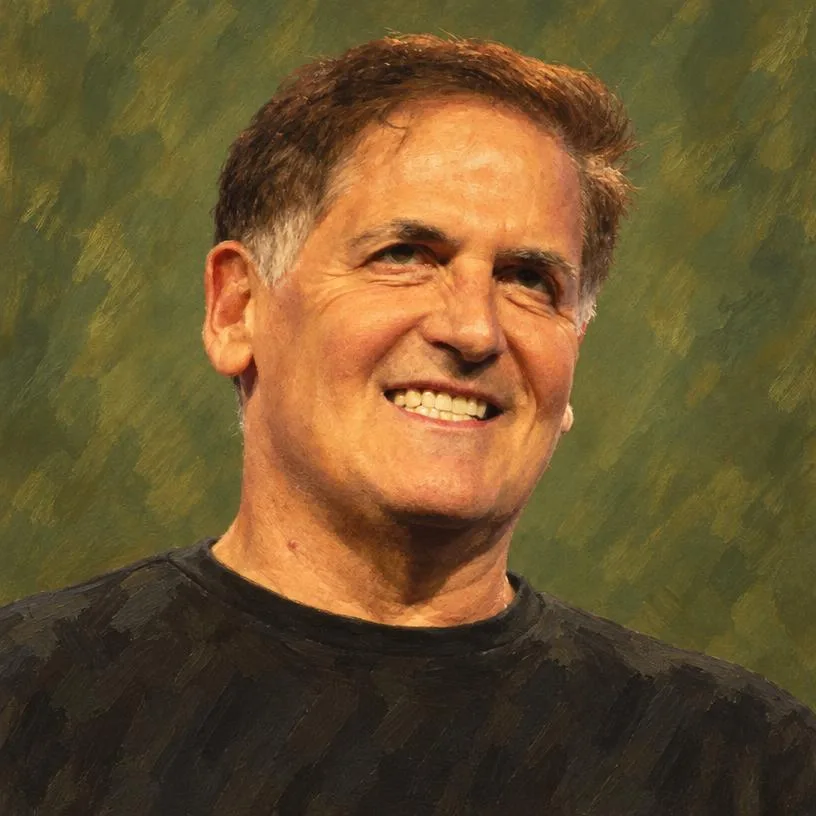
Mark Cuban
Entrepreneur, investor and Shark Tank star
Mark Cuban went from selling garbage bags door to door to selling Broadcast.com for billions, and now backs founders on Shark Tank while preaching curiosity, sales and relentless effort.
“Work like there is someone working twenty-four hours a day to take it all away from you.”
Listen to story & lessons
The story
Mark Cuban was born in 1958 in Pittsburgh, Pennsylvania, to a working-class family — his father did automobile upholstery, and Cuban sold garbage bags door to door at twelve to pay for basketball shoes. He studied business at Indiana University because it was the cheapest good business school he could find, then moved to Dallas, where he slept on the floor of a shared apartment and taught himself to program from manuals. Fired from a software sales job after choosing a sales call over opening the store, he started his own company, MicroSolutions, and sold it in 1990 for about six million dollars. He was thirty-two, retired for a while, and bought a lifetime pass on American Airlines.
Retirement did not last. In 1995, Cuban and Todd Wagner started AudioNet, later Broadcast.com, to stream sports games over the young internet — a business most people thought was absurd. They took it public in 1998 and sold it to Yahoo in 1999 for 5.7 billion dollars in stock, near the very top of the dot-com bubble. Cuban famously hedged his Yahoo shares, protecting his fortune through the crash. In 2000 he bought the Dallas Mavericks, then one of the worst franchises in the NBA, and turned them into champions in 2011 through aggressive spending, analytics and a courtside presence that earned him millions in league fines. He joined Shark Tank in 2011 and became its most recognizable investor.
Cuban's later career mixes business with public argument. He founded Cost Plus Drugs in 2022 to sell generic medications at transparent cost-plus prices, a genuine attempt to attack a real problem, and he spars constantly on social media about politics, markets and other billionaires. His record has blemishes: the SEC charged him with insider trading in 2008 — a jury cleared him in 2013 — and a 2018 Sports Illustrated investigation found a corrosive culture inside the Mavericks organization, which he said he failed to see and moved to fix. He sold his majority stake in the Mavericks in 2023, keeping a minority share and operational role.
Cuban's appeal as a teacher is that his advice is unglamorous and testable. He insists sales is the core skill of every business, that preparation beats passion, and that the one thing fully in your control is effort. He is blunt about luck — he calls his own billions partly a matter of timing — which makes his work ethic argument more honest, not less: you cannot control the market, but you can control whether you are the best-prepared person in the room when it moves. For a reader, the Cuban formula is small and demanding: learn constantly, sell honestly, spend less than you make, and outwork the version of you that wants to coast.
Accomplishments
- In 1990, he sold his software company MicroSolutions for about six million dollars.
- In 1999, he sold Broadcast.com to Yahoo for 5.7 billion dollars.
- In 2000, he bought the Dallas Mavericks, who won the NBA championship in 2011.
- In 2022, he launched Cost Plus Drugs to sell generic medications at transparent prices.
Top 10 lessons
- 01
Selling is helping — start there.
Cuban defines selling as helping: put yourself in the other person's position and ask whether your product genuinely serves them. Practice by explaining one idea this week entirely in terms of what the listener gains.
- 02
Work like someone is trying to take it all away.
His famous line about someone working around the clock to take it away is about paranoia as fuel. Translate it sanely: assume your skills have a shelf life, and refresh them before the market asks you to.
- 03
Learn constantly; business never stands still.
He reads constantly because business never stands still. Build a small daily learning habit — an article, a chapter, a technical video — and treat it as part of the job, not a hobby.
- 04
Sweat equity beats borrowed money.
Cuban started with no investors and calls sweat equity the best capital. Before borrowing money or raising funds, ask what you could build with your own hours first; ownership you keep is worth more than speed you rent.
- 05
Know your numbers cold.
He insists founders know their numbers — margins, costs, cash — without checking. Learn the basic math of your own finances and work until you can answer from memory; vagueness is where trouble hides.
- 06
Stay curious or get left behind.
His answer to 'what makes a great entrepreneur' starts with curiosity. Pick one area of your work where your knowledge is two years old and close the gap this month.
- 07
Don't start a company unless it's an obsession.
Cuban tells would-be founders not to start unless the idea is an obsession, because the hard years will test exactly that. Before committing, ask whether you would still want this project if it took twice as long and paid half as much.
- 08
Treat customers like they own you — because they do.
He reminds founders that customers can leave at any time, so they effectively own you. Make it easy for the people you serve to complain, and treat every complaint as free consulting.
- 09
Adapt fast when the market changes.
Broadcast.com pivoted repeatedly as the internet changed. Review your own plans quarterly: what assumption has aged badly, and what would you do differently if you started today?
- 10
Effort is the one thing fully in your control.
Cuban says effort is the only variable you fully control — not markets, not luck, not timing. When a goal stalls, ask honestly whether you have done the unglamorous work available to you before blaming the conditions.