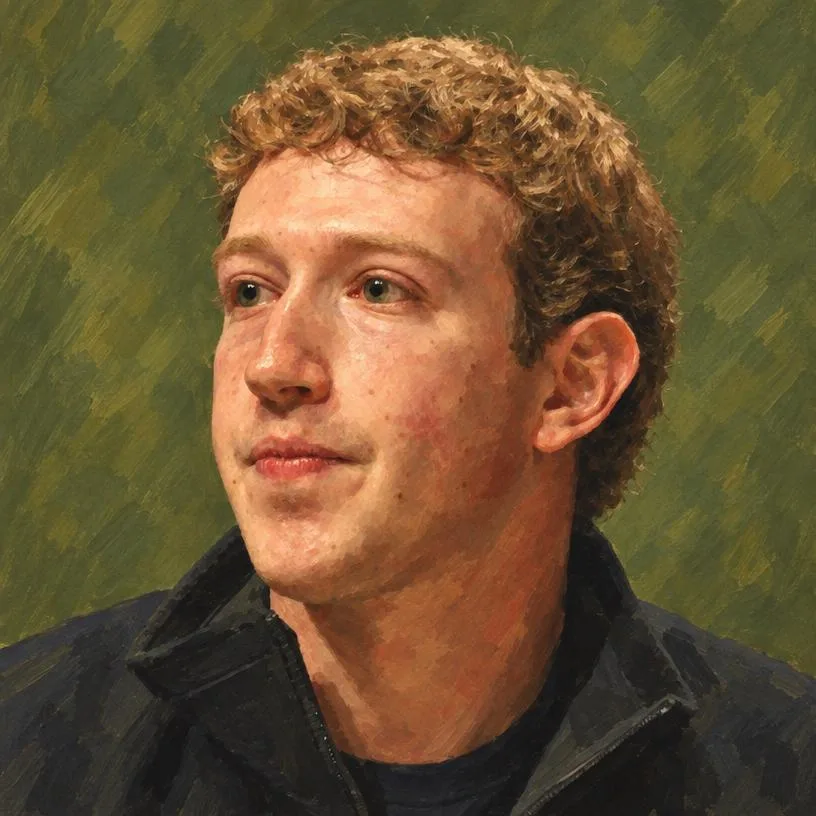
Mark Zuckerberg
Meta co-founder and CEO
Mark Zuckerberg built Facebook from a dorm-room project into a company used by billions, betting repeatedly that connecting people is worth moving fast and weathering criticism.
“The biggest risk is not taking any risk.”
Listen to story & lessons
The story
Mark Zuckerberg was born in 1984 in White Plains, New York, and was writing software before high school — his father taught him programming, and a private tutor reportedly found him a difficult student to keep ahead of. At Harvard he built a string of campus projects, including a hot-or-not site called Facemash that nearly got him disciplined, and in February 2004 he launched TheFacebook from his dorm room. Within weeks it spread to other universities; within a year he had dropped out and moved to Palo Alto. The founding was famously contentious: the Winklevoss twins and Divya Narendra accused him of taking their idea, a dispute settled for a reported 65 million dollars in cash and stock.
Facebook's growth was relentless: high schools, then everyone over thirteen, then the News Feed, the Like button, and the acquisitions of Instagram in 2012 and WhatsApp in 2014. Zuckerberg kept control through a dual-class share structure that left him answerable mostly to himself. The company's early motto, 'move fast and break things', captured a genuine engineering culture — ship, measure, fix — and also an attitude toward consequences that the company would spend years answering for. In 2021 he renamed the company Meta and bet its future on virtual and augmented reality, a wager that cost tens of billions before AI became the company's next great focus.
No honest account of Zuckerberg can skip the criticism. Facebook's handling of user data produced the Cambridge Analytica scandal and a record five-billion-dollar FTC fine. The platform was used to spread misinformation and, in Myanmar, hate speech linked to real-world violence; the company acknowledged it had not done enough. Zuckerberg testified before Congress, apologized repeatedly, and rebuilt the company's rules and teams. Supporters see a founder who learned hard lessons in public; critics see a pattern of growth first, accountability later. Both readings draw on the same record.
What a reader can usefully take is the builder's discipline underneath the controversy. Zuckerberg's strength was never a single brilliant idea — social networks existed before Facebook — but rapid iteration, personal technical competence, and an unusual willingness to make unpopular long-term bets. His annual personal challenges, from learning Mandarin to running a mile a day, show a habit of treating himself as a project. The balanced lesson: move fast on things that are cheap to fix, and slowly on things that are not — and know which is which before you start.
Accomplishments
- In 2004, he launched Facebook from his Harvard dorm room at age nineteen.
- In 2012, Facebook went public in one of the largest technology listings ever, and he bought Instagram for about one billion dollars.
- In 2014, Facebook acquired WhatsApp for roughly 19 billion dollars.
- In 2021, he renamed the company Meta and committed it to building the metaverse.
Top 10 lessons
- 01
Move fast and learn from what breaks.
Facebook shipped features before they were polished and fixed them in public. For your own projects, separate what is cheap to change — a draft, a habit, a prototype — from what is not, and move fast only on the first kind.
- 02
The biggest risk is not taking any risk.
Zuckerberg's most quoted line is that the biggest risk is taking none. The usable version: in a changing world, standing still is also a bet — usually an unexamined one. Name the risk of doing nothing before you choose it.
- 03
Start with a problem you understand personally.
Facebook began as a tool for campuses Zuckerberg lived in. Your best project ideas are the problems you personally keep hitting; you will understand the user because you are one.
- 04
Done is better than perfect.
'Done is better than perfect' hung on Facebook's walls for years. Set a version-one bar you can reach this week, ship it to a small audience, and let real use — not imagination — write the next to-do list.
- 05
Build for the long term, not the headlines.
He held Instagram and WhatsApp bets for years before they paid off, despite mockery. When you believe in something with a long fuse, decide in advance what evidence would change your mind — then ignore everything shorter than that.
- 06
Give people tools to connect and share.
Facebook's core insight was that people want tools to connect, not content to consume. Whatever you build — a business, a family ritual, a community — design for the relationships, and the rest follows.
- 07
Recruit people you would work for.
Zuckerberg has said he only hires people he could imagine working for. Use the test in reverse when choosing jobs and partners: would you take direction from this person? If not, the arrangement will strain.
- 08
Focus on a few clear priorities.
Facebook's product reviews famously forced teams to name the one metric that mattered. Give your own month a headline priority; if everything is important, nothing is.
- 09
Treat criticism as data — listen, then decide.
He absorbed years of public criticism while continuing to make unpopular bets. Build your own filter: extract the useful signal from criticism, answer it once, and do not let the loudest voice set your strategy.
- 10
Keep shipping; momentum compounds.
Facebook's culture measured output in shipped code, not plans. Track what you actually finish — pages written, workouts done, calls made — because momentum you can see is momentum that continues.
Books
- No books yet — start with the interviews.