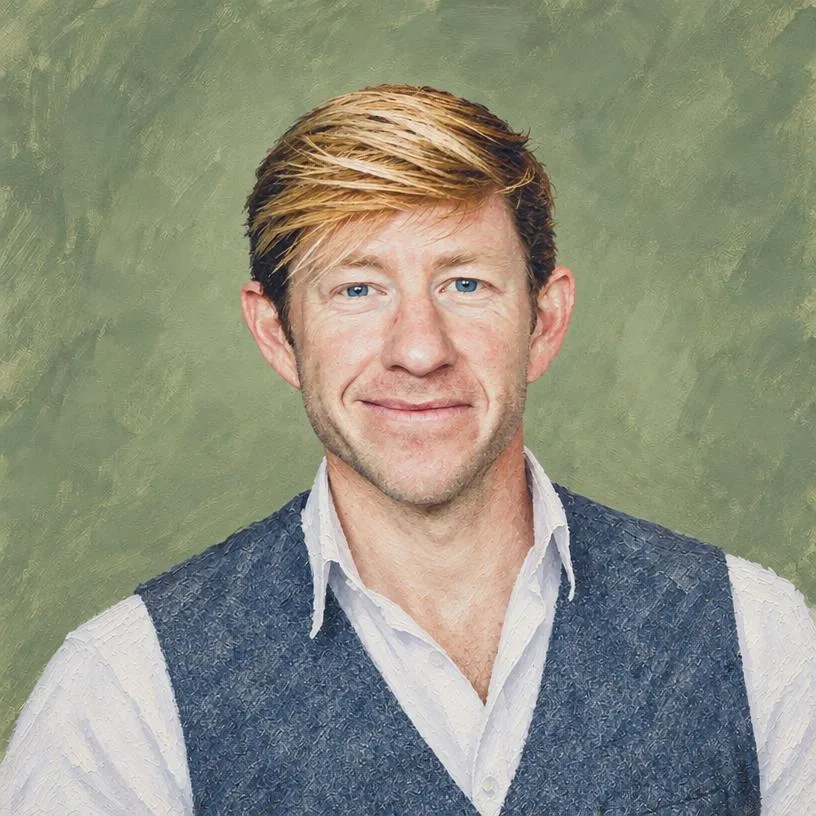
Matthew Walker
Sleep scientist and bestselling author
Matthew Walker is a neuroscientist and author who helps people understand sleep and build gentler, more consistent routines for learning, health, and everyday wellbeing.
“Motor skill learning is maximized when we get a full night’s sleep.”
Listen to story & lessons
The story
Matthew Walker grew up in Liverpool and Chester in England before pursuing neuroscience at the University of Nottingham. He completed his undergraduate degree in 1996 and a doctorate at Newcastle University in 1999. His early research concerned changes in consciousness in people with neurodegenerative disease, an important background to his later questions about sleeping and waking. Rather than approaching sleep simply as a lifestyle preference, he came to it through the study of the brain. That distinction matters when reading his advice: the strongest foundation is the experimental work on what sleep does, not the idea that one routine fits everyone. His career eventually took him to the United States, where sleep research became the central thread connecting his laboratory work, teaching, and public communication.
Walker became relevant first through research, including a 2002 study of sleep and motor learning with colleagues at Harvard Medical School. Participants practiced a keyboard sequence, and the researchers compared later performance after periods containing sleep or wakefulness. The findings helped make a concrete idea accessible: improvement can continue after practice has ended, and sleep can contribute to that process. Walker subsequently held a Harvard faculty position before moving to the University of California, Berkeley, in 2007. There he developed a research program investigating sleep, memory, emotion, aging, and health. His later public explanations drew heavily on this laboratory background. For readers, the useful takeaway is not a guarantee of overnight mastery, but a reason to include recovery in any serious learning plan.
His 2017 book Why We Sleep brought those ideas to a much wider audience and became a bestseller. Talks and long-form interviews made him one of the most recognizable public voices on sleep. That prominence also brought substantive criticism. Independent researcher Alexey Guzey challenged numerous factual claims and interpretations in the book, and statistician Andrew Gelman also criticized its presentation of evidence. One disputed claim concerned an alleged World Health Organization declaration of a sleep-loss epidemic; Walker later acknowledged misremembering the attribution. These controversies should not be hidden behind his popularity or academic position. They are a reminder to distinguish established findings from sweeping health claims, and to avoid treating observational associations as proof that a specific amount of sleep determines an individual’s fate.
The most useful application of Walker’s work is practical and proportionate: make room for sleep, keep reasonably regular hours, and create conditions that make rest easier. His accounts of learning research offer a persuasive alternative to celebrating exhaustion as evidence of commitment. At the same time, sleep is not an exam that must be passed perfectly every night. A reader can adopt sensible habits without accepting every dramatic statistic in a popular book or interpreting a difficult night as lasting damage. Persistent insomnia or excessive daytime sleepiness deserves professional care, not simply greater discipline. Read his public advice alongside independent clinical guidance, and use the science to support a calmer relationship with rest rather than adding another source of pressure to an already demanding day.
Accomplishments
- In 1999, he completed a doctorate at Newcastle University.
- In 2002, he coauthored the Neuron study Practice with Sleep Makes Perfect on sleep-dependent motor learning.
- In 2007, he joined the University of California, Berkeley, after working at Harvard.
- In 2017, he published Why We Sleep, which became a New York Times bestseller.
Top 10 lessons
- 01
Keep a consistent sleep schedule.
Choose a wake-up time you can usually maintain, including on weekends, and work toward a similarly steady bedtime. Walker repeatedly emphasizes regularity because the body follows a daily timing system; start with a realistic schedule rather than trying to compensate for every difficult night with a large shift.
- 02
Give sleep enough room in your day.
Reserve enough time for sleep instead of treating it as whatever remains after work and entertainment. Walker generally discusses seven to nine hours for adults; use that range as a starting point, not a nightly performance test, and notice whether you feel rested and alert during the day.
- 03
Get daylight early in your waking day.
Step outside for daylight after waking when your schedule allows, and build some outdoor time into the day. Walker explains that light helps set the circadian clock; combine morning light with a consistent waking time rather than expecting one gadget or one perfect evening routine to solve everything.
- 04
Dim your evenings before bed.
Lower household lighting as bedtime approaches and reduce stimulating screen use if it keeps you alert. In Walker’s account, evening light can interfere with the normal timing of sleepiness; a quiet, dim wind-down is a practical experiment, not a demand to eliminate every device or buy special glasses.
- 05
Keep your bedroom comfortably cool.
Make the room cool enough to feel comfortable and adjust bedding to avoid overheating. Walker discusses the fall in core body temperature associated with sleep onset; try a modest environmental change first, rather than chasing an exact thermostat number that ignores your comfort, climate, or health needs.
- 06
Move caffeine earlier in the day.
If falling asleep is difficult, move your last coffee or energy drink earlier and observe the difference over several days. Walker highlights caffeine’s long-lasting effects and individual variation; feeling able to fall asleep after coffee does not necessarily tell you everything about the quality of that night’s sleep.
- 07
Avoid using alcohol as a sleep aid.
Do not confuse feeling sedated with getting restorative sleep. Walker explains that alcohol can disrupt sleep later in the night; try an alcohol-free evening when assessing your routine, and speak with a clinician before changing consumption abruptly if you might be dependent or have concerns about withdrawal.
- 08
Protect sleep around important learning.
When studying or practicing a skill, plan sleep both before the session and afterward instead of relying on an all-night push. Walker’s laboratory work links sleep with learning and memory; a practical approach is to practice attentively, stop at a sensible time, and return after a normal night.
- 09
Leave bed briefly when wakefulness becomes frustrating.
If you are lying awake and becoming increasingly frustrated, get up for a quiet activity in dim light and return when sleepy. Walker presents this as a way to avoid teaching your brain that bed means wakefulness; avoid clock-watching, and do not turn the break into work or entertainment.
- 10
Seek help for persistent sleep problems.
Use sleep habits as support, not as a substitute for assessment when insomnia, loud snoring, breathing pauses, or daytime sleepiness persist. Walker discusses cognitive behavioral therapy for insomnia; ask a qualified clinician about appropriate treatment rather than diagnosing yourself from a podcast or becoming more anxious about sleep scores.