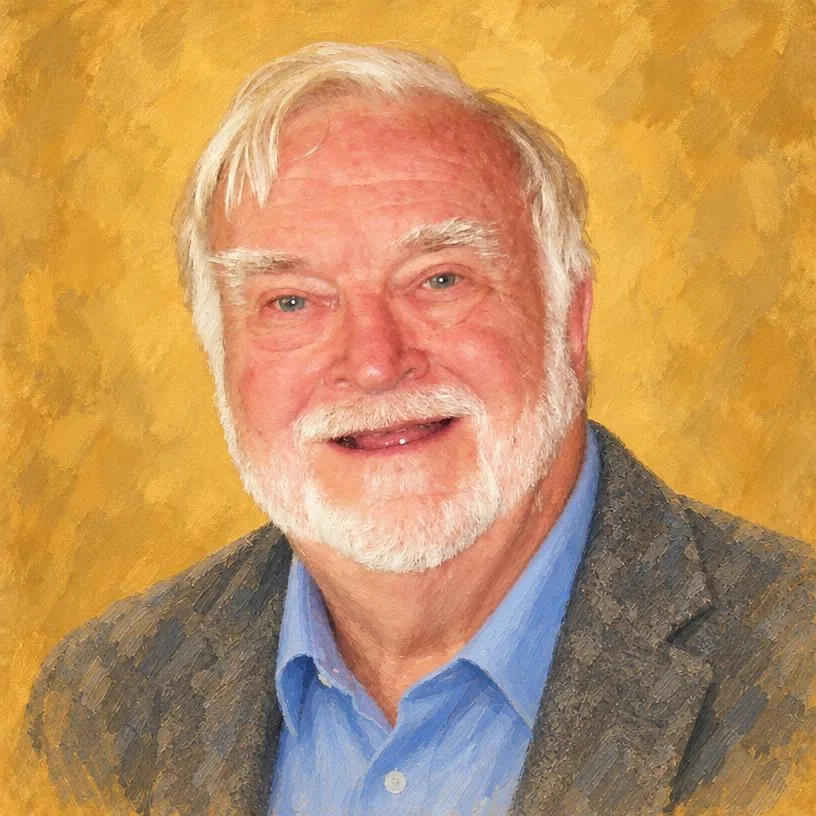
Mihaly Csikszentmihalyi
Psychologist and pioneer of flow research
Mihaly Csikszentmihalyi studied how deep engagement makes life rewarding, helping people discover greater enjoyment through focused attention, meaningful challenges, and the growth of skills.
“Optimal experience is thus something that we make happen.”
Listen to story & lessons
The story
Mihaly Csikszentmihalyi was born in 1934 in Fiume, then part of Italy and now Rijeka, Croatia, into a Hungarian family. His father worked in diplomacy, and the family’s circumstances changed dramatically around the Second World War and its aftermath. They lived in postwar Rome, where his father eventually ran a restaurant and Mihaly helped support the family. Seeing adults struggle after losing security, status, and familiar social structures left him curious about what makes life worth living. His interests ranged across art, philosophy, and religion before psychology became his profession. An encounter with a lecture by Carl Jung in Switzerland helped point him toward that field. The question that followed him was not simply how to avoid pain, but how people find worthwhile experience.
He moved to the United States in 1956 and studied at the University of Chicago, earning his doctorate in 1965 through research on artistic creativity with Jacob Getzels. After teaching at Lake Forest College, he returned to Chicago’s faculty in 1971. Observing artists, he became interested in the way making something could become so absorbing that ordinary concerns temporarily disappeared. His research widened beyond exceptional creators to people describing everyday activities. With colleagues, he helped develop experience-sampling methods using prompts and questionnaires to capture what people were doing and feeling throughout the day. This mattered because accounts of happiness could then include ordinary lived moments, not only broad retrospective judgments. The work helped establish his distinctive account of attention, enjoyment, and optimal experience.
Flow: The Psychology of Optimal Experience, published in 1990, carried these ideas far beyond academic psychology. Csikszentmihalyi described a state of intense involvement in which attention is concentrated, goals are clear, feedback is available, and challenges fit a person’s skills. Later books explored creativity, personal development, and work. After retiring from Chicago in 1999, he continued at Claremont Graduate University, where he founded the Quality of Life Research Center and worked with Jeanne Nakamura. He also collaborated with Martin Seligman on a 2000 article introducing positive psychology. The appeal of flow should not obscure the limits of the evidence: self-reported experience does not establish a universal recipe, and an absorbing activity is not necessarily ethical, healthy, or available equally to everyone.
Csikszentmihalyi died in 2021 at the age of eighty-seven, leaving an influential vocabulary for experiences many people recognize but struggle to explain. His central practical insight was that enjoyment can come from active engagement rather than passive comfort alone. That does not mean every hour should become productive, or that rest is inferior to effort. It means people can experiment with how they use attention: choose a worthwhile task, define the next step, get feedback, and adjust its difficulty as skills develop. His life’s question also remains larger than individual performance. Concentration becomes more valuable when connected to meaningful commitments and responsible action. For a reader today, flow is best approached as one helpful part of a good life, not as a promise that hardship or unhappiness can be eliminated.
Accomplishments
- Earned a Ph.D. at the University of Chicago in 1965 for research on artistic creativity.
- Published Flow: The Psychology of Optimal Experience in 1990.
- Published Creativity: Flow and the Psychology of Discovery and Invention in 1996.
- Coauthored the introductory American Psychologist article on positive psychology with Martin Seligman in 2000.
Top 10 lessons
- 01
Match a meaningful challenge to your skills.
Csikszentmihalyi described flow as deep involvement that often arises when demanding challenges meet developed skills. Choose a task slightly beyond your comfort zone, then adjust its difficulty: simplify it if you feel overwhelmed, or add a meaningful constraint if boredom makes sustained attention difficult to maintain.
- 02
Define the next goal clearly.
Clear goals help attention settle on the activity rather than drift between competing demands. Before a focused session, specify one immediate objective, such as practicing a difficult musical passage or solving one design problem; keep the larger ambition in view without trying to accomplish every stage at once.
- 03
Seek feedback while you work.
Flow is supported by knowing how your actions are going, not merely waiting for a distant final judgment. Build a short feedback loop into your activity by checking a result, listening closely, or comparing a draft against a clear criterion; use that information to adjust your next attempt.
- 04
Protect your attention from interruptions.
Csikszentmihalyi treated attention as a limited resource that shapes the quality of experience. Put away your phone, close unrelated windows, and choose a realistic stretch of uninterrupted work; do not demand instant absorption, but create conditions in which your mind can gradually become involved in one manageable challenge.
- 05
Choose activities worth doing for themselves.
An autotelic activity is rewarding in its own right rather than only because it produces money, praise, or status. Notice what you enjoy practicing even without an audience, and make room for it regularly; external rewards can matter, but they need not become the sole reason you participate.
- 06
Study your everyday experience.
Csikszentmihalyi’s experience-sampling research asked people to report what they were doing and feeling during ordinary life. Try a simple personal version for a week: record your activity, concentration, and enjoyment at several daily moments, then look for patterns rather than assuming your favorite pastime always leaves you fulfilled.
- 07
Turn ordinary tasks into engaging challenges.
Flow need not be limited to elite performance or dramatic creative breakthroughs. Add a clear goal and useful feedback to an everyday task, such as preparing a meal with better timing or learning a new route on a walk; keep the challenge safe and meaningful rather than manufacturing unnecessary stress.
- 08
Increase difficulty as your abilities grow.
A challenge that once absorbed you can become dull as your skills improve. Revisit an activity you already know and add one new technique, standard, or level of complexity; Csikszentmihalyi’s model suggests that sustained engagement often requires growth, not endlessly repeating the same comfortable performance without further learning.
- 09
Connect your efforts to a larger purpose.
Csikszentmihalyi’s broader work links optimal experience with the organization of a meaningful life. Look beyond an absorbing afternoon and ask how your activities fit together: choose commitments that build skills, relationships, or contributions you value, rather than collecting isolated intense experiences that leave your wider life fragmented.
- 10
Ask whether your absorption serves something good.
Absorption alone does not establish that an activity is wise or ethical. Alongside Csikszentmihalyi’s interest in responsible work, examine what your most engaging habits produce for yourself and others; protect sleep, relationships, and obligations, and do not treat losing track of time as automatic evidence of a flourishing life.