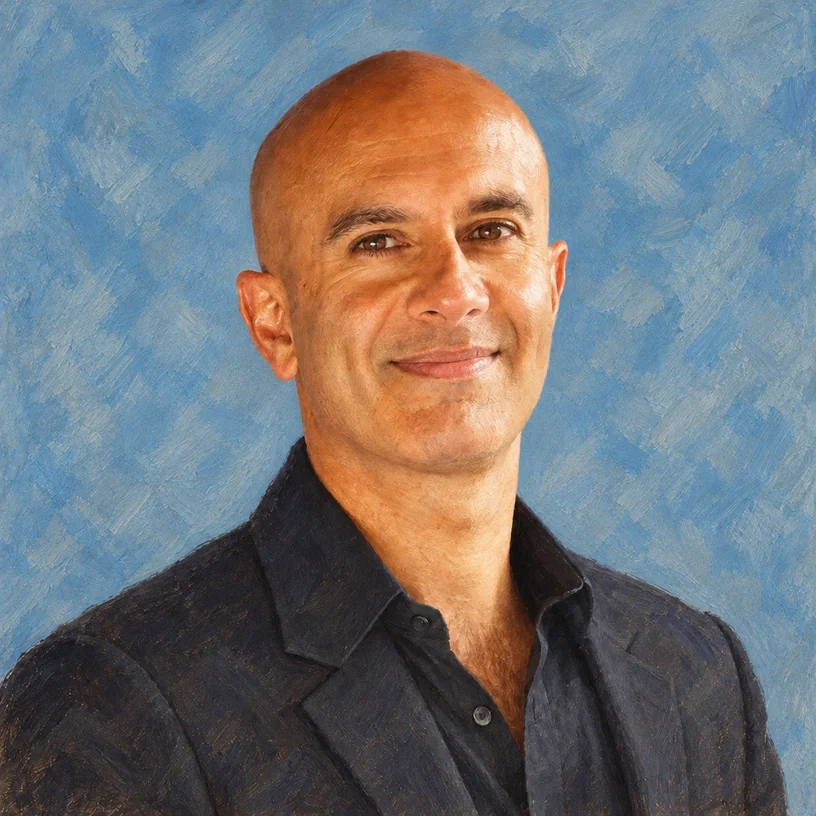
Robin Sharma
Leadership author and former litigation lawyer
Robin Sharma walked away from a legal career to self-publish a fable about a lawyer who sells everything to find a meaningful life — and became one of the world's most widely read voices on leadership, mornings and personal mastery.
“The smallest of actions is always better than the noblest of intentions.”
Listen to story & lessons
The story
Robin Sharma was born in 1964 in Port Hawkesbury, Nova Scotia, and grew up in Canada in a family that valued education and discipline — his father was a physician, his mother a teacher. He studied law, earned two degrees including a master's, and built a successful career as a litigation lawyer. By his own account, the outside looked impressive and the inside felt empty: long hours, constant pressure, and a growing sense that he was living someone else's definition of success. He began reading widely about philosophy, spirituality and human potential, searching for a different way to live.
In his early thirties, Sharma did something his colleagues considered reckless: he quit law to write. His first book, MegaLiving, attracted little attention. His second, a fable about a high-powered lawyer who suffers a heart attack, sells his Ferrari and travels to the Himalayas to learn from sages, was rejected by the publishing establishment — so he self-published The Monk Who Sold His Ferrari in 1997, selling copies out of his home and speaking to any group that would have him. Word of mouth did the rest. The book became an international phenomenon, eventually selling millions of copies in dozens of languages, and HarperCollins picked it up for worldwide distribution.
The success turned Sharma into one of the most sought-after leadership speakers in the world. His client list came to include Fortune 500 companies, professional athletes, musicians and billionaires, and books like The Leader Who Had No Title and The Greatness Guide extended his core idea: leadership is a way of behaving, not a position on an org chart. In 2018 he published The 5 AM Club, a book he spent four years writing, built around the 'Victory Hour' — the first hour of the day split into twenty minutes each of exercise, reflection and learning. It became another bestseller and turned his morning method into a global movement.
What a reader can usefully take from Sharma is the mechanics underneath the inspiration. His message is not that everyone must wake at five, but that the first hour of the day sets the trajectory of the other twenty-three — and that most people spend it reacting to other people's priorities. His fables argue that outer success without inner work is fragile, and that small, almost invisible daily disciplines matter more than dramatic gestures. The balanced lesson: you do not need to sell your Ferrari, but you probably do need to decide, deliberately, what your mornings and your attention are for.
Accomplishments
- In 1997, he self-published The Monk Who Sold His Ferrari, which became an international bestseller translated into dozens of languages.
- In 2010, he published The Leader Who Had No Title, extending his message that leadership is behavior, not position.
- In 2018, he released The 5 AM Club, a worldwide bestseller that popularized his Victory Hour morning method.
- Over his career, his books have sold more than fifteen million copies and he has advised Fortune 500 companies, athletes and public figures on leadership.
Top 10 lessons
- 01
Own your morning and you own your day.
Sharma's central claim is that the first hour of the day disproportionately shapes the rest of it. You do not have to rise at five — but do decide what your first hour is for, instead of handing it to notifications and other people's urgency.
- 02
Protect the first hour for movement, reflection and learning.
The 20/20/20 formula splits the morning's first hour into movement, reflection and learning. Try a simplified version tomorrow: ten minutes of each, before you open your inbox, and notice what changes by midday.
- 03
Small daily improvements compound into mastery.
He argues that mastery is the accumulation of small, consistent acts — what he calls the compounding of daily improvements. Pick one tiny upgrade to your craft or health and repeat it for sixty-six days, the period his habit protocol suggests for making it automatic.
- 04
Leadership is for everyone, title or not.
The Leader Who Had No Title argues that leadership is example, not rank. Find one place this week — at work, at home, among friends — where you can raise the standard simply by how you show up, without waiting for permission.
- 05
Guard your focus like it's your fortune.
Sharma treats focus as the scarcest modern asset and builds his days around distraction-free work blocks. Choose your single most important task each morning and give it ninety uninterrupted minutes before anything reactive.
- 06
Do the hard thing first, while your will is strong.
His fables repeatedly send characters toward the thing they fear — the lawyer toward the mountains, the tycoon toward stillness. Identify the uncomfortable task you keep postponing and schedule it first, when your willpower is at its daily peak.
- 07
Rest and recovery are part of elite performance.
The 5 AM Club insists that elite performers protect sleep, rest and recovery as fiercely as work. Audit your evenings: an earlier, calmer night is what makes a deliberate morning possible at all.
- 08
Let your work be an act of service.
Sharma frames great work as service — the monk's lesson is that a life built only for the self eventually feels empty. Ask who benefits from your work beyond you, and let that answer guide one decision this week.
- 09
Choose courage over comfort, daily.
His characters grow only when they trade comfort for courage — leaving the firm, selling the car, starting over. Name one small comfort you could exchange for growth this month, and make the trade while it is still your choice.
- 10
Leave every person and place better than you found them.
The sages in his fables measure a life by what it leaves behind in people. End each day with his simplest question: who is better because of something I did today? Keep the answer written down — it becomes its own motivation.