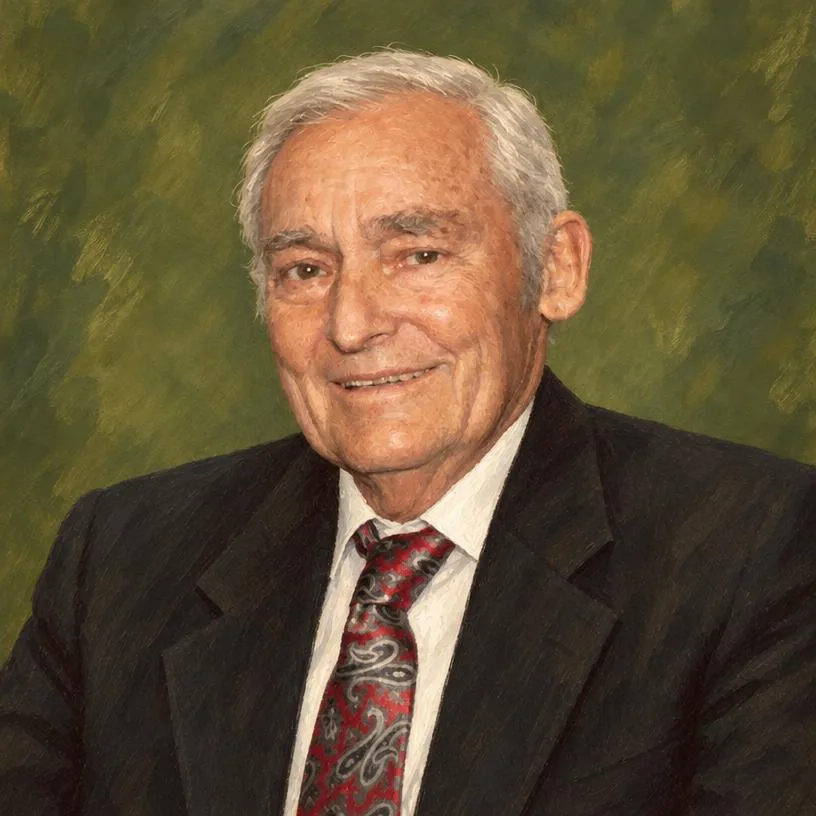
Sam Walton
Walmart founder
Sam Walton built Walmart from a single small-town store into the world's largest retailer by obsessing over low prices, listening to frontline employees and outworking every competitor.
“There is only one boss: the customer.”
Listen to story & lessons
The story
Sam Walton was born in 1918 in Kingfisher, Oklahoma, and grew up during the Depression in Missouri, where he worked paper routes, milked cows and sold magazine subscriptions to help his family. He was an Eagle Scout, a quarterback, and by his own account an ordinary student with an extraordinary willingness to work. He studied economics at the University of Missouri, took a management trainee job at JCPenney for 75 dollars a month, served in the Army during the Second World War, and in 1945 — at twenty-seven, with a 20,000-dollar loan from his father-in-law — bought a Ben Franklin variety store in Newport, Arkansas. When the landlord refused to renew his lease in 1950, he lost the store and started over in Bentonville.
Walton's insight was geographic as much as commercial: the big discount chains ignored small towns, and small towns wanted low prices too. He opened the first Walmart in Rogers, Arkansas, in 1962 — the same year Kmart, Target and Woolco all launched — and grew by saturating rural territory the giants considered worthless, building his own warehouses and trucks so stores could be restocked faster and cheaper than anyone else's. He visited stores constantly, flew his own plane to scout locations, and famously danced the hula on Wall Street in 1984 after losing a bet with his employees about profit margins. Walmart went public in 1970 and became the largest retailer in America by 1991.
Walton's legacy carries real controversy. Walmart's growth devastated many small-town main streets, and the company has faced decades of criticism over low wages, anti-union practices and the pressure it applies to suppliers — criticisms that intensified after his death but began in his lifetime. He was also, by many accounts, genuinely frugal and unpretentious: he drove an old pickup, flew coach, and shared profits with hourly 'associates' decades before stock plans were common. He received the Presidential Medal of Freedom in March 1992, weeks before dying of bone cancer at seventy-four. His autobiography, Made in America, remains one of the most cited books in retail.
The heart of Walton's method is humility in service of learning. He never believed he was the smartest person in retail; he believed he could out-visit, out-listen and out-copy anyone. He walked competitors' stores with a tape recorder, asked clerks what sold, and treated every employee idea as worth testing. That is a practice available to anyone: stay close to the actual work, listen to the people nearest the customer, and let your ego spend its energy on improvement rather than image. Frugality, in his telling, was not miserliness — it was respect for the customer who pays for everything.
Accomplishments
- In 1945, he bought his first variety store in Newport, Arkansas, with a loan from his father-in-law.
- In 1962, he opened the first Walmart in Rogers, Arkansas.
- In 1970, Walmart went public, funding its expansion across the American South and Midwest.
- In 1992, he received the Presidential Medal of Freedom, weeks before his death.
Top 10 lessons
- 01
Treat the customer as the only real boss.
Walton said the customer can fire everyone in the company simply by shopping elsewhere. Identify who your 'customer' is — a boss, a client, a reader — and let their verdict, not your preference, judge your work.
- 02
Commit to your business completely.
He called total commitment the first rule of his success: believe in your business more than anyone else does. Half-hearted projects rarely survive their first hard year, so choose work you can genuinely stand behind.
- 03
Share profits with the people who create them.
Walmart shared profits with hourly workers when that was almost unheard of. If you lead anyone — a team, a family project — give people a real stake in the outcome, not just instructions.
- 04
Communicate everything you can to your team.
Walton pushed information down to store clerks so they could act without asking permission. In your group, share the 'why' and the numbers; people make better decisions when they can see what you see.
- 05
Appreciate people out loud.
He made a show of praising good work in person, in stores, by name. Appreciation costs nothing and is chronically underused — tell one person this week exactly what they did well.
- 06
Celebrate success and find humor in failure.
The hula on Wall Street was a lost bet paid in full, in public. Keep your promises especially when they embarrass you, and let your failures become stories instead of secrets.
- 07
Listen to everyone in the company.
Walton's Saturday morning meetings existed to hear ideas from every level. Ask the people closest to the problem what they would change — then visibly act on at least one suggestion.
- 08
Exceed your customers' expectations.
His rule was to give customers a little more than they expect. Find the small surplus — faster replies, a tidier handoff, a follow-up — that makes people come back without being asked.
- 09
Control expenses better than the competition.
Walmart's entire advantage was built on spending less than rivals on everything except the customer. Audit your own expenses the same way: cut what the customer never sees, protect what they feel.
- 10
Swim upstream — question conventional wisdom.
Everyone said discount stores could not survive in small towns; Walton built an empire on the exception. When conventional wisdom is unanimous, check whether it is evidence — or just habit wearing a suit.