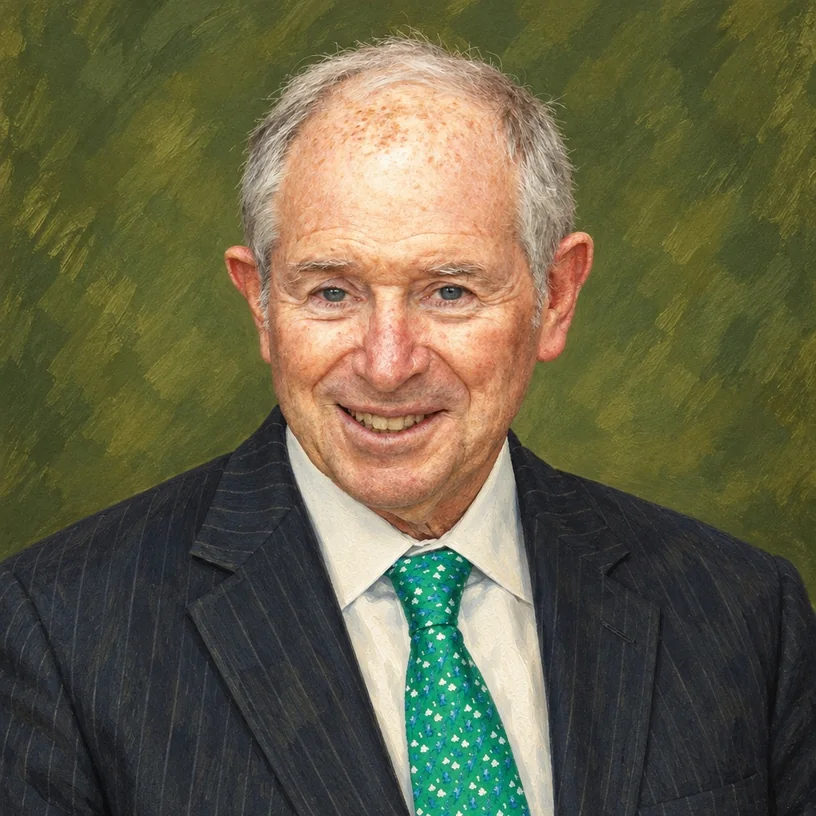
Stephen Schwarzman
Co-founder, chairman and CEO of Blackstone
Stephen Schwarzman co-founded Blackstone with Peter Peterson and developed it into a major alternative investment firm. His experience emphasizes fundraising, demanding preparation, and risk review, while leveraged investing and concentrated financial power warrant careful scrutiny.
“The best executives are made, not born. They absorb information, study their own experiences, learn from their mistakes, and evolve.”
The story
Stephen Schwarzman grew up around his father’s retail linen business before attending Yale and Harvard Business School. He built a finance career at Lehman Brothers, eventually leading its mergers and acquisitions work. In 1985, he and Peter Peterson founded Blackstone, beginning with advisory work and ambitions in investing. Their established careers did not make fundraising effortless; Schwarzman’s memoir describes the difficulty of convincing prospective investors to support a new institution. The practical lesson is to distinguish personal credentials from a compelling customer proposition. Experience can open a meeting, but a new business still needs a clear purpose, credible execution, and an answer to why someone should commit money now.
Blackstone expanded across private equity, real estate, credit, and other alternative investment strategies. Its growth depended on raising capital from outside investors and deploying that capital through specialized teams, not simply trading Schwarzman’s own money. The firm went public in 2007, the same year its funds agreed to acquire Hilton in a transaction valued at about $26 billion. The subsequent financial crisis put severe pressure on leveraged investments and hospitality demand. Hilton eventually became a highly profitable investment for Blackstone, but the outcome should not obscure the uncertainty along the way. A practical takeaway is that surviving adverse conditions can matter as much as identifying an attractive asset initially.
Schwarzman’s account of Blackstone emphasizes learning from mistakes and subjecting proposed investments to searching internal review. Those practices are useful, yet they do not erase the structural risks of leverage, illiquid holdings, or incentives tied to investment performance. Alternative asset managers also influence employees, tenants, borrowers, and communities whose interests can differ from those of fund investors. A balanced reading separates disciplined underwriting from a blanket endorsement of every transaction. Readers should examine fees, debt obligations, governance, and exit assumptions before treating a celebrated deal as a model. An investment can reward its owners while still generating legitimate questions about how its gains and costs are distributed.
Beyond investing, Schwarzman has funded education and cultural institutions, including Schwarzman Scholars at Tsinghua University and a major gift supporting MIT’s College of Computing. He published What It Takes in 2019, framing his career as a set of lessons about building organizations and pursuing ambitious goals. Such advice is best treated as experienced judgment rather than a universal formula: institutional access, market timing, and the ability to withstand losses differ greatly between readers. The most portable takeaway is to combine demanding preparation with mechanisms for correction. Choose work worth sustained effort, recruit people who can challenge you, and build an organization whose standards do not depend entirely on the founder’s presence.
Accomplishments
- Co-founded Blackstone with Peter Peterson in 1985.
- Led Blackstone through its 2007 public listing and expansion across alternative investment strategies.
- Published What It Takes: Lessons in the Pursuit of Excellence in 2019.
- Announced a $350 million gift in 2018 supporting the MIT Schwarzman College of Computing.
Top 10 lessons
- 01
Choose a problem worth sustained effort.
Define why the opportunity matters, who needs the result, and whether the potential justifies years of work. Schwarzman favors ambitious undertakings, but ambition needs a credible market and workable economics. Write a small initial test before committing resources to the largest version of your idea.
- 02
Prepare before asking for capital.
Research the prospective investor’s mandate, constraints, and decision process before presenting. Explain the opportunity, the risks, your role, and the specific commitment you seek. Fundraising becomes clearer when you help someone make an informed decision rather than assuming enthusiasm or professional status will close the gap.
- 03
Study the downside before the upside.
Build a conservative case that includes lower revenue, higher costs, and a slower exit. Identify what would threaten survival rather than merely reduce returns. Leveraged investing makes downside analysis especially important because a temporary operating problem can become permanent loss when debt payments cannot wait.
- 04
Invite disagreement before committing.
Assign someone knowledgeable to challenge the proposal and require an answer to their strongest objection. Encourage doubts before approval rather than punishing them afterward. A demanding review works only when junior people can surface inconvenient facts without fearing that disagreement will damage their standing.
- 05
Treat timing as part of the decision.
Ask what depends on current prices, financing conditions, customer demand, or regulatory approval. Decide which signals justify waiting and which justify acting. Timing is not perfect prediction; it is recognizing that the same asset or business can have very different prospects under different entry conditions.
- 06
Match financing to a difficult scenario.
Compare payment obligations with cash flow under stress, not just under the expected case. Avoid financing that requires a quick recovery to prevent default. Hilton’s crisis-era experience illustrates why patience is valuable only when lenders, investors, and operating cash provide enough room to exercise it.
- 07
Develop people through explicit standards.
Explain what excellent work looks like through examples, review criteria, and timely feedback. Give capable people responsibility with support rather than expecting them to infer every expectation. High standards become a development system when people can understand and meet them, not merely fear disappointing the leader.
- 08
Separate persistence from sunk-cost thinking.
Set review dates and conditions for changing course before investing heavily. At each review, ask whether you would begin the project today with what you now know. Persistence is useful when the case remains sound; money already spent is not evidence that the next commitment makes sense.
- 09
Consider stakeholders beyond the deal.
List the people affected by a transaction and examine how changes in debt, pricing, staffing, or ownership could affect them. Include legal duties and reputational consequences in the analysis. A profitable investment deserves scrutiny beyond investor returns, particularly when people cannot easily change employer or provider.
- 10
Build institutions that outlast individual influence.
Document investment principles, decision rights, and succession responsibilities so expertise survives departures. In philanthropy, give institutions room for independent judgment rather than relying only on donor prominence. The strongest legacy is a capable organization that continues learning and serving its purpose after its founder steps back.